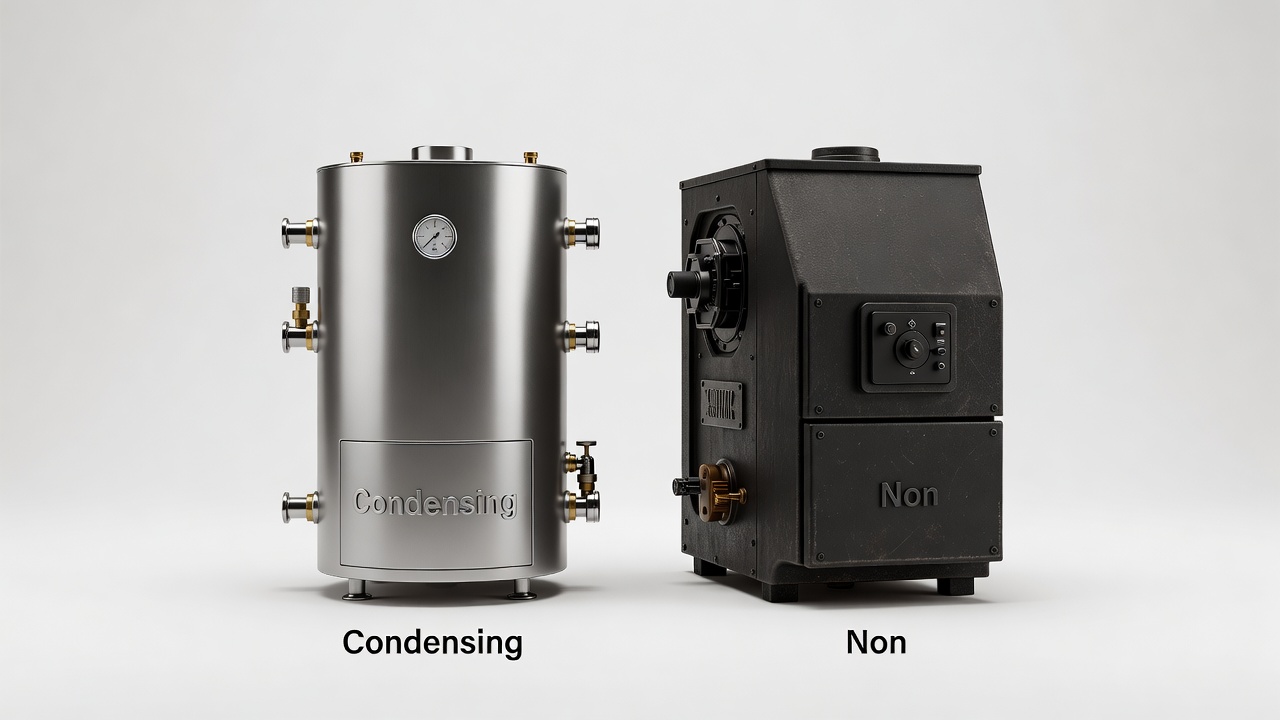
Condensing vs Non-Condensing Tankless Water Heaters: Efficiency & Real Cost Savings
Affiliate Disclosure: TanklessGeek participates in the Amazon Services LLC Associates Program. We earn commissions from qualifying purchases through our Amazon links at no extra cost to you. We recommend products based on specifications, performance, and value, not commission rates.
Quick Picks: Our 2026 Top Choices
| Pick | Model | Type | GPM | BTU | Best For |
|---|---|---|---|---|---|
| Best Whole-Home | Rinnai RX199iN | Condensing | 11.1 | 199,000 | Large families, cold climate |
| Best Mid-Size | Rinnai RXP160iN | Condensing | 9.0 | 160,000 | 3-4 person homes with recirc |
| Best Budget Condensing | Takagi T-H3-DV-N | Condensing | 10.0 | 199,000 | Value-focused contractor specs |
| Best Non-Condensing | Rheem RTG-70DVLN-3 | Non-Condensing | 7.0 | 160,000 | Warm climates, lower upfront cost |
UEF Ratings: What the Numbers Actually Mean
Uniform Energy Factor (UEF) replaced Energy Factor in 2017 as the standard efficiency metric for residential water heaters. UEF measures how much of the input energy becomes hot water at the tap, accounting for standby losses (zero for tankless) and cycling.
| Type | Typical UEF Range | Real-World Efficiency | Heat Exchangers |
|---|---|---|---|
| Non-Condensing | 0.80 - 0.85 | 80 - 85% | Single |
| Condensing | 0.90 - 0.96 | 90 - 98% | Primary + secondary |
That 10-16 percentage point gap means a condensing unit burns 10-18% less fuel for the same hot water output. For a household using 64 gallons per day (national average), the annual savings run $100-$250 depending on local natural gas or propane rates.
How Condensing Technology Works
Non-condensing tankless units vent exhaust gases at 300-400°F. That's wasted heat. Condensing models route exhaust through a secondary heat exchanger, where incoming cold water absorbs the residual energy and cools the flue gases below 120°F. The cooled vapor condenses into liquid (hence the name), releasing latent heat that preheats the incoming water before it hits the primary burner.
Result: less fuel burned to reach target temperature, and cooler exhaust that allows PVC venting instead of stainless steel (though many pros still prefer stainless for durability).
Upfront Cost Difference
Condensing units cost more due to the secondary heat exchanger, condensate neutralizer kit, and more complex venting requirements.
| Item | Non-Condensing | Condensing |
|---|---|---|
| Unit Price | $800 - $1,500 | $1,300 - $2,300 |
| Installation Labor | $500 - $1,200 | $600 - $1,500 |
| Venting Material | Stainless steel | PVC or stainless |
| Total Installed | $1,300 - $2,700 | $1,900 - $3,800 |
Price premium: $500-$1,100 for comparable flow capacity. High-output condensing models (9+ GPM) often push the gap closer to $1,500.
Best Condensing Models on Amazon (2026)
Rinnai RX199iN - Best for Whole-Home High Demand
UEF 0.98, 199,000 BTU, up to 11.1 GPM. The Rinnai RX199iN tops the residential condensing lineup with Energy Star qualification and adaptive gas valve tech. Indoor or outdoor install, natural gas or propane. Wi-Fi app lets you monitor usage and adjust temp remotely. Priced around $2,200-$2,500 before install.
Best for: Large families (5+ people), simultaneous showers + dishwasher + laundry, cold climate where groundwater dips below 50°F in winter.
Rinnai RXP160iN - Mid-Capacity Sweet Spot
160,000 BTU, up to 9 GPM. The Rinnai RXP160iN balances efficiency and output for 3-4 person households. Built-in recirculation pump support cuts the wait for hot water in homes with long pipe runs. Reviews praise reliability and consistent temp control. Around $1,800-$2,000.
Best for: Standard family homes, moderate climate, existing recirc system or planning to add one.
Takagi T-H3-DV-N - Best Budget Condensing
199,000 BTU, up to 10 GPM. The Takagi T-H3-DV-N delivers condensing efficiency at non-condensing pricing (typically under $1,500). Direct vent design simplifies install. Takagi's 15-year limited warranty on heat exchanger adds peace of mind. Fewer smart features than Rinnai, but solid performance for buyers prioritizing value.
Best for: Budget-conscious buyers, contractors doing spec installs, homes without smart home integration needs.
Maintenance Burden: Condensing vs Non-Condensing
Both types need annual descaling in hard water areas. Condensing units add one extra maintenance task: condensate system service.
Annual Descaling
Frequency depends on water hardness. Standard recommendation: once per year. Hard water regions (15+ grains per gallon): every 6-9 months. Professional flush service runs $150-$350. DIY with a submersible pump and white vinegar costs $20-$50 in supplies after the initial pump purchase ($120-$160).
Condensing and non-condensing tankless units descale identically. The secondary exchanger in condensing models adds surface area but does not materially increase descaling time or cost.
Condensate Trap/Neutralizer Maintenance
Condensing units produce acidic condensate (pH 3-4) that corrodes standard drain pipes. A condensate neutralizer kit (limestone media cartridge) raises pH to safe levels before discharge. Replace the media annually or per manufacturer spec. Cartridge cost: $40-$80. Labor if you hire it out: $75-$150.
Neglecting the neutralizer voids warranties and risks drain pipe corrosion. Add this to your annual service checklist if you go condensing.
Total Annual Maintenance Cost
- Non-condensing: $150-$350 (descaling only, DIY or pro)
- Condensing: $200-$500 (descaling + condensate system service)
Condensing adds $50-$150 per year in maintenance. Over a 15-year lifespan, that's $750-$2,250 extra.
Payback Timeline: When Condensing Makes Financial Sense
Payback depends on four variables: upfront cost premium, annual fuel savings, local energy rates, and household hot water usage.
Scenario 1: High-Usage Cold Climate (Best Case for Condensing)
- Family of 5, 80 gallons/day usage
- Cold groundwater (45°F winter average)
- Natural gas at $1.50/therm (Midwest 2026 average)
- Cost premium: $800 (condensing over non-condensing)
- Annual fuel savings: $220
- Extra maintenance: $100/year
- Net annual benefit: $120
- Payback: 6.7 years
Scenario 2: Moderate-Usage Warm Climate (Marginal Case)
- Family of 3, 50 gallons/day usage
- Warm groundwater (65°F year-round)
- Natural gas at $1.20/therm (Southeast 2026 average)
- Cost premium: $1,000
- Annual fuel savings: $110
- Extra maintenance: $75/year
- Net annual benefit: $35
- Payback: 28.6 years
In warm climates with low-to-moderate usage, non-condensing often wins on total cost of ownership. Condensing payback stretches beyond the typical 15-20 year lifespan.
Scenario 3: Propane Users (Strong Case for Condensing)
- Family of 4, 64 gallons/day
- Propane at $3.00/gallon (rural 2026 average)
- Cost premium: $900
- Annual fuel savings: $280
- Extra maintenance: $100/year
- Net annual benefit: $180
- Payback: 5 years
Propane costs 2-3x natural gas per BTU. Higher fuel prices magnify efficiency gains. Condensing units pay for themselves faster when propane is the only option.
Non-Condensing Still Has a Place
Non-condensing tankless units remain the right choice in specific scenarios:
- Low hot water usage: Single occupant, vacation home, or point-of-use applications where annual fuel costs are under $200. Efficiency gains do not justify the upfront premium.
- Budget constraints: Lower equipment and install costs free up capital for other energy upgrades (insulation, windows) with higher ROI.
- Warm climate + inexpensive natural gas: Payback timelines stretch past the unit's lifespan when groundwater temps stay above 60°F and gas rates stay below $1.00/therm.
- Venting challenges: Retrofit installs in homes with limited vertical vent runs or masonry chimneys sometimes favor non-condensing units with higher exhaust temps that prevent condensation in the flue.
Best Non-Condensing Models on Amazon (2026)
Rinnai RE140iN (Indoor, 5.3 GPM, 140,000 BTU): Reliable mid-capacity non-condensing unit for 2-3 person households. Around $1,000-$1,200. View on Amazon.
Rinnai RE140eN (Outdoor, 5.3 GPM, 140,000 BTU): Same internals as RE140iN, weather-resistant cabinet for exterior mounting. Simplifies venting in retrofit installs. View on Amazon.
Rheem RTG-70DVLN-3 (Indoor, 7.0 GPM, high-efficiency non-condensing): Balances efficiency (UEF 0.82) and cost. Direct vent design. Good middle-ground for families hesitant to jump to condensing. Around $1,100-$1,400. View on Amazon.
Venting Differences and Installation Complexity
Exhaust temperature drives venting material requirements.
| Type | Exhaust Temp | Vent Material Options | Installation Notes |
|---|---|---|---|
| Non-Condensing | 300-400°F | Stainless steel, Type B vent (some models) | Requires clearances to combustibles, vertical or power vent |
| Condensing | 100-120°F | PVC, CPVC, polypropylene, or stainless | Flexible routing, side-wall venting allowed, needs condensate drain |
PVC venting saves $200-$400 on material costs versus stainless. Condensing units allow horizontal side-wall venting in retrofit situations where vertical runs are impractical. However, you must route a condensate drain line to a floor drain, sump, or exterior discharge point. That adds plumbing complexity non-condensing installs avoid.
When to Choose Condensing
- High hot water usage (70+ gallons/day)
- Cold climate (groundwater below 55°F in winter)
- Propane fuel source (higher cost per BTU amplifies efficiency gains)
- Long-term homeownership (10+ years to recoup premium)
- Access to condensate drainage without major plumbing work
- Willingness to maintain the condensate neutralizer annually
When to Choose Non-Condensing
- Low-to-moderate usage (under 50 gallons/day)
- Warm climate with inexpensive natural gas
- Budget-constrained install where every dollar counts
- Point-of-use applications (single sink, shower, or appliance)
- Retrofit where side-wall venting is not possible and vertical clearance favors high-temp exhaust
- Preference for simpler maintenance (descaling only, no condensate system)
The 2026 Verdict
Condensing tankless water heaters deliver measurable efficiency gains - 10-16 percentage points over non-condensing models. In high-usage cold-climate homes with propane or expensive natural gas, the payback lands in the 5-8 year range. That's a solid investment if you plan to stay put.
Non-condensing units still make sense for lower-usage households, warm climates, tight budgets, and retrofit installs where venting complexity tilts the scales. The efficiency gap narrows when groundwater temps stay above 60°F and natural gas rates stay low.
Run your own payback math: estimate annual hot water fuel cost, apply the 10-15% efficiency gain condensing delivers, subtract the extra maintenance cost, and divide the equipment premium by the net annual savings. If the result is under 10 years and you plan to stay in the home longer, condensing is the right call. If payback stretches past 15 years, stick with non-condensing and invest the savings elsewhere.
For related guidance, see our full breakdown of tankless vs tank water heater ROI and our cold climate buyer's guide to high-altitude tankless installs.
Frequently Asked Questions
Is condensing always better than non-condensing tankless?
Not always. Condensing is better for high-usage cold-climate homes and propane users, where the 10-16 efficiency point gain pays back in 5-8 years. For low-usage warm-climate homes on inexpensive natural gas, non-condensing usually wins on total cost of ownership because payback stretches beyond the unit's 15-20 year lifespan.
How much can I save per year with a condensing tankless?
Annual fuel savings run $100-$250 for a household using 64 gallons per day on natural gas. Propane users can save $200-$350 per year because propane costs 2-3x natural gas per BTU. Subtract $50-$150 per year in extra condensate system maintenance to get the net benefit.
What is the UEF rating difference between condensing and non-condensing?
Non-condensing tankless heaters carry UEF ratings of 0.80-0.85 (80-85% efficient). Condensing models hit UEF 0.90-0.96 (90-98% efficient). The 10-16 percentage point gap means a condensing unit burns 10-18% less fuel for the same hot water output.
Why do condensing units need a condensate drain?
Condensing units cool exhaust gases below 120F, which causes water vapor in the exhaust to condense into acidic liquid (pH 3-4). That condensate must drain to a floor drain, sump, or exterior discharge point, and must pass through a neutralizer cartridge first to prevent corrosion of standard drain pipes. Non-condensing units vent exhaust at 300-400F so no condensation forms.
Can I use PVC venting with a non-condensing tankless?
No. Non-condensing units exhaust at 300-400F, well above the temperature rating of PVC and CPVC pipe. Non-condensing requires stainless steel Category III vent. PVC venting is only allowed on condensing units because cooled exhaust stays under 140F.
How often does a condensing tankless need maintenance?
Annual descaling like any tankless heater, plus annual condensate neutralizer cartridge replacement. Total annual maintenance cost is $200-$500 for condensing vs $150-$350 for non-condensing. In hard water regions (15+ grains per gallon), descale every 6-9 months instead of yearly.
Is the upfront cost difference worth it for a small household?
Usually not. A 1-2 person household using under 50 gallons per day has annual fuel costs under $200, so the 10-15% efficiency gain saves only $20-$30 per year. With $500-$1,100 upfront premium plus extra maintenance, payback exceeds the unit's lifespan. Non-condensing makes more sense for small households unless propane is the fuel source.
Do condensing tankless heaters qualify for tax credits or rebates?
Many condensing models with UEF 0.95+ qualify for the federal Energy Efficient Home Improvement Credit (up to 30% of cost, capped at $600 for gas water heaters under current rules). Some utilities offer additional $100-$500 rebates for high-efficiency tankless installs. Check with your gas utility and state energy office before purchase, and confirm Energy Star qualification on the specific model.
Affiliate Disclosure: TanklessGeek participates in the Amazon Services LLC Associates Program, an affiliate advertising program designed to provide a means for sites to earn commissions by linking to Amazon.com. We earn commissions from qualifying purchases made through our Amazon links at no additional cost to you. These commissions support our research, testing, and content creation. We recommend products based on specifications, performance, and value, not commission rates.
Photos provided by Pexels.