Best Recirculation Pump for Tankless Water Heaters 2026: Retrofit Guide
Affiliate Disclosure: TanklessGeek participates in the Amazon Services LLC Associates Program. We earn commissions from qualifying purchases through our Amazon links at no extra cost to you. We recommend products based on specifications, performance, and value, not commission rates.
Quick Picks: Best Add-On Recirculation Pumps for Tankless Heaters
| Model | Compatibility | Mode | Best For | Check Price |
|---|---|---|---|---|
| PROZRTED HBS24-12 Top Pick | Tankless + tanked | Demand / timer / manual | No return line, existing tankless owners | Check Price on Amazon |
| Grundfos GRU-595916 | Tankless with dedicated return line | Timer + aquastat | New builds, whole-house coverage, plumber-spec | Check Price on Amazon |
| Rinnai REP199iN Built-In Alt | N/A - factory-integrated | Smart-Circ learning schedule | New installation replacing existing unit | Check Rinnai REP199iN Price on Amazon |
Why Most Recirculation Pumps Do Not Work with Tankless Heaters
A standard tank-style recirculation pump - including the Watts 0955800 and Watts Heat H2O 0955805 - is specifically listed by Watts as "not designed for tankless water heaters." The same limitation applies to the popular Laing AutoCirc and most crossover-valve budget pumps.
The problem is minimum flow activation. Every tankless water heater requires a minimum water flow (typically 0.4 to 0.75 GPM depending on model) to open the flow sensor and fire the burner. A standard crossover recirculation pump moves 0.5 to 1.5 GPM through the system continuously or on a timer - enough to keep triggering the burner every few minutes, even at 2 AM when no one needs hot water. This short-cycling wastes gas and stresses the heat exchanger.
Fortunately, there are purpose-built options that solve this. Here is how to choose the right one.
How a Crossover Valve System Works (No Return Line Required)
Most homes do not have a dedicated return line - a separate pipe running from the farthest fixture back to the water heater. Installing one means opening walls and is a major plumbing job ($400 to $1,200 in labor). The crossover valve system avoids all of that.
Here is how it works:
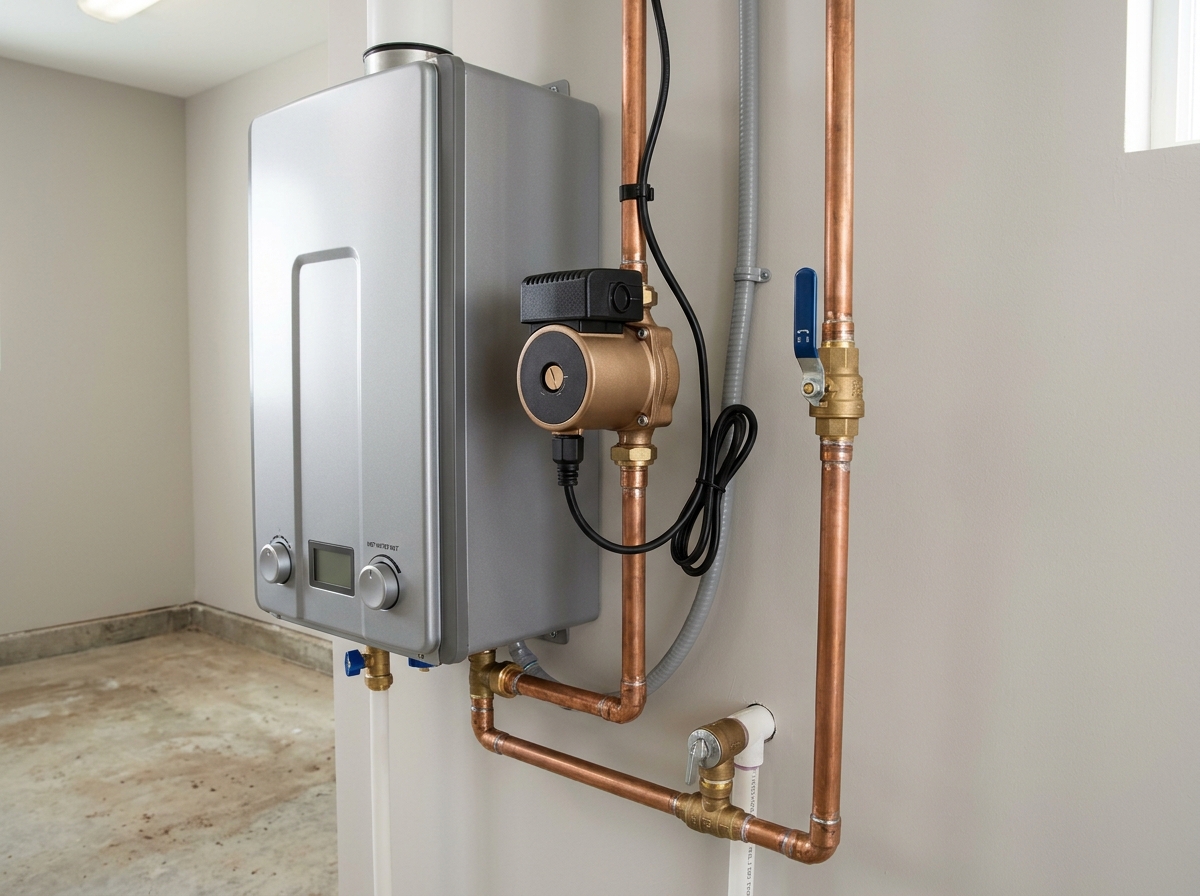
- The pump mounts at the water heater on the hot water outlet (or nearby).
- A crossover (bypass) valve mounts under the farthest sink from the heater.
- When the pump runs, it pushes hot water toward the fixtures through the hot line.
- As hot water advances, the cooled water that was sitting in the hot line gets pushed through the crossover valve into the cold supply line and flows back to the water heater.
- When the pipe at the crossover valve warms to the set temperature, the valve closes - stopping the loop.
For tankless heaters, the key is that the crossover valve closes before warm water arrives at the cold inlet of the tankless unit in sufficient volume to trigger firing. Demand mode - where the pump only runs when you press a button before stepping in the shower - achieves this most cleanly.
PROZRTED HBS24-12: Best Tankless-Compatible Add-On Pump
The PROZRTED HBS24-12 is the most straightforward tankless-compatible retrofit pump available on Amazon in 2026. It is NSF/ANSI 61 and 372 certified (safe for drinking water), uses a 24V DC brushless motor (quiet, low-maintenance), and explicitly supports both tankless and tanked water heaters in its product specifications.
At 6.1 GPM maximum flow and 39.3-foot maximum head, it handles most residential pipe runs. The built-in thermostat controls the pump and stops circulation once the line reaches the set temperature - which prevents unnecessary tankless burner activation. Three-speed operation lets you tune flow to stay below your specific heater's minimum activation threshold if you are using timer mode.
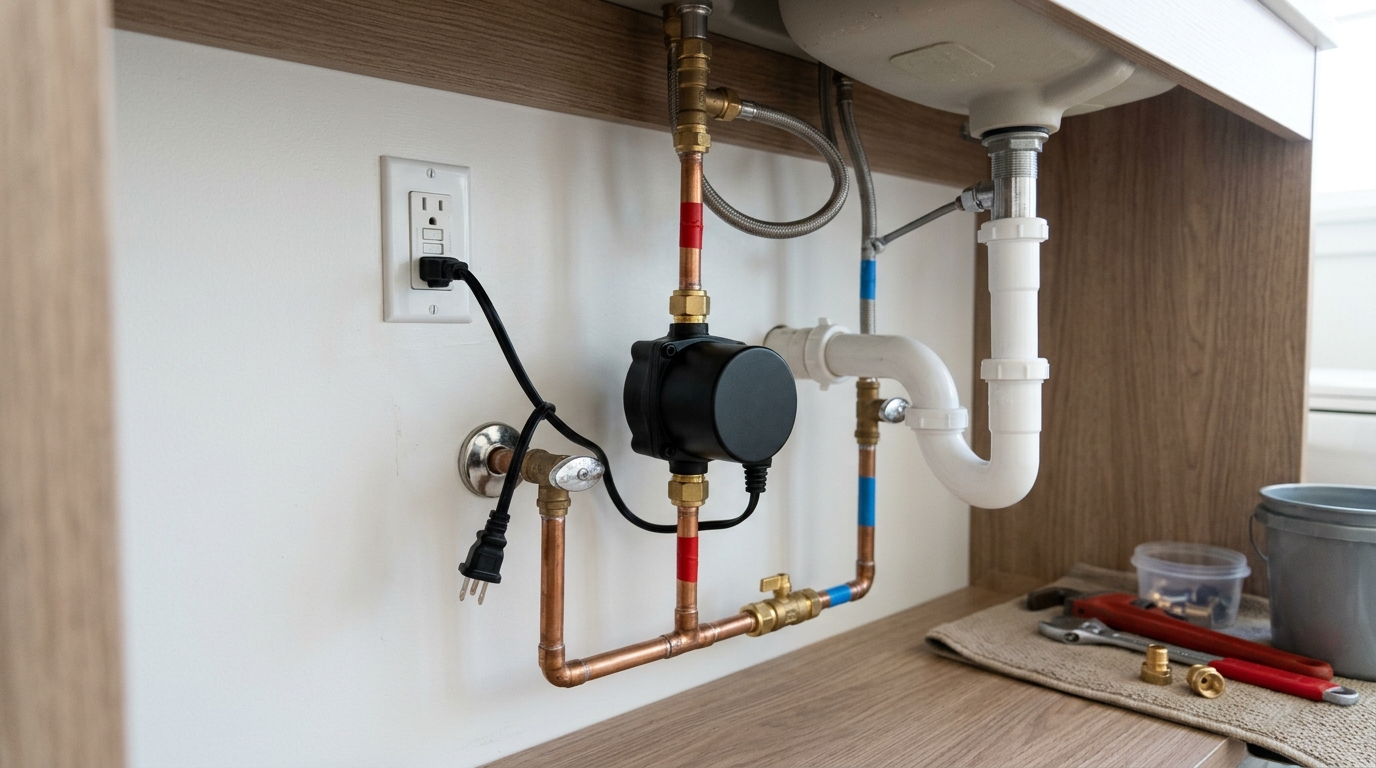
Installation: The HBS24-12 mounts under the sink at the farthest point from the water heater, not at the heater itself. Hot and cold lines connect to the pump body, and the built-in sensor shuts the pump off when the hot side reaches temperature. No separate crossover valve to source. The kit includes connection hoses and a brass tee. Installation is a 45-minute DIY job with basic hand tools.
Modes: Manual mode (push button, runs until temperature reached, then 60-minute auto-off), timer mode, or fully automatic thermostat mode. For tankless heaters, manual demand mode is the recommended starting point.
Price: Approximately $175 on Amazon. Total installed cost with a plumber: $325 to $450.
Grundfos GRU-595916: Best for New Builds and Plumber-Spec Installs
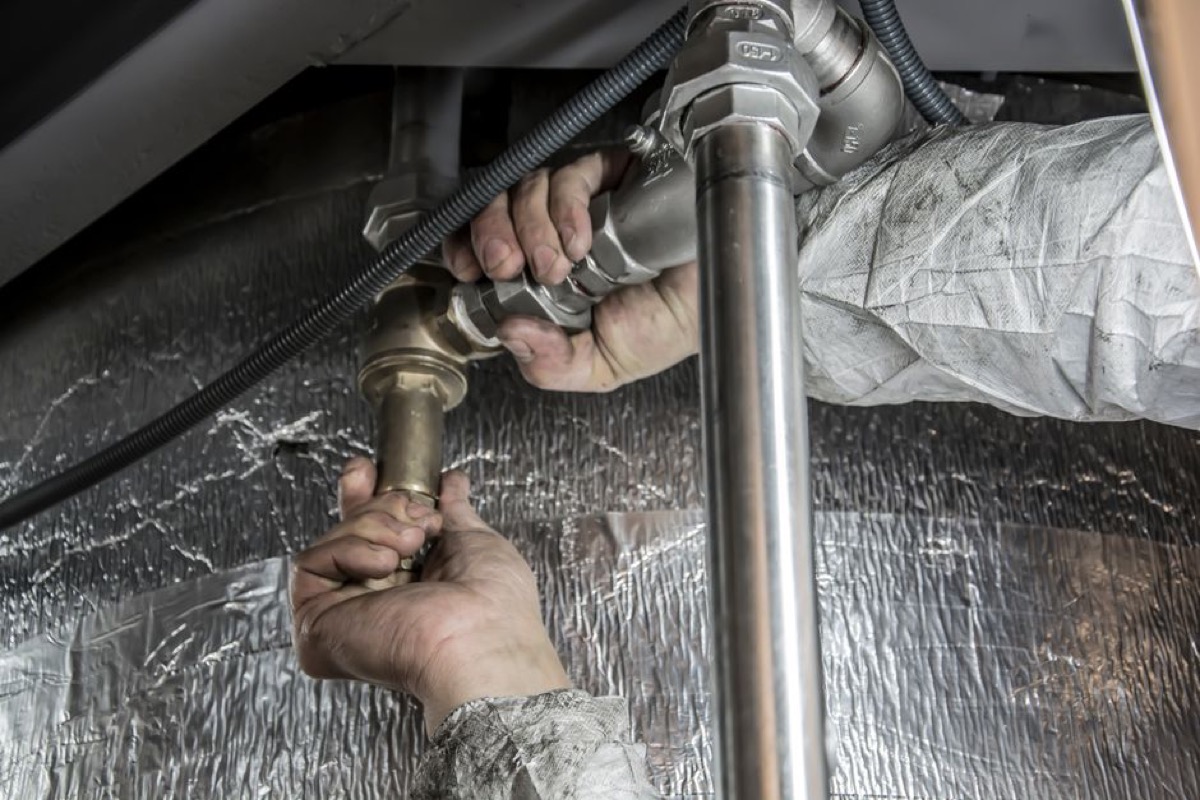
The Grundfos 595916 is the industry reference pump - the model plumbers specify by name when a client asks for a recirculation pump with no brand preference. It is a 25-watt bronze and stainless unit with a 9 GPM flow rate, a built-in timer, and a 6-foot line cord. It mounts at the water heater on the hot supply outlet using 3/4-inch FNPT connections.
For tankless heaters, the Grundfos 595916 requires a dedicated return line with an aquastat to operate correctly. The aquastat monitors pipe temperature on the return side and cuts power to the pump when the water is already hot enough, preventing unnecessary flow and burner cycling. If you are building a new home or doing a full mechanical room upgrade where a return line is practical, this is the cleanest long-term installation.
Without a dedicated return line, the Grundfos can be used in a crossover configuration, but the aquastat control becomes more important - you need to ensure the pump does not circulate cool water back through the cold inlet in a way that triggers your tankless unit to fire when no fixture is open.
Price: Approximately $281 on Amazon. Total installed cost with a plumber and dedicated return line: $600 to $1,500+ depending on plumbing complexity.
Built-In vs. Add-On: When to Upgrade the Whole Unit Instead
If you already own a tankless water heater that is working correctly, an add-on pump is the right answer. Replacing a functioning unit to get a built-in pump is not economical.
But if you are in the market for a new tankless heater anyway, the math favors built-in recirculation. The Rinnai REP199iN (built-in Smart-Circ) costs roughly $100 to $150 more than the non-pump RE199iN at retail. A quality add-on pump plus plumber labor runs $300 to $600. The built-in option wins on total cost for new installs and eliminates the external hardware, separate electrical outlet, and additional warranty exposure of an add-on system.
| Approach | Unit Cost | Add-On Pump | Labor | Total |
|---|---|---|---|---|
| Rinnai REP199iN (built-in pump) | ~$1,440 | $0 | Baseline | Baseline |
| Rinnai RE199iN + PROZRTED HBS24-12 | ~$1,060 | ~$176 | +$200-300 | +$36-96 more |
| Rinnai RE199iN + Grundfos 595916 | ~$1,060 | ~$281 | +$200-400 | +$141-341 more |
The Rinnai REP199iN is the right buy for new installs where recirculation is part of the plan from the start.
Check Rinnai REP199iN Price on Amazon
Tankless Compatibility Checklist Before You Buy
Before purchasing an add-on recirculation pump for your tankless heater, verify these five points:
- Minimum flow rate: Find your tankless unit's activation threshold in the installation manual (usually 0.4 to 0.75 GPM). Choose a pump with speed settings that allow you to run below this threshold, or commit to using demand mode only.
- Pump certification: NSF/ANSI 61 and 372 means the pump materials are safe for potable water. Do not skip this - pumps without it may leach metals into your drinking water.
- Mode options: Demand mode is the safest for tankless. Avoid pumps that only offer continuous mode.
- Return line situation: No return line in the walls means you need a crossover valve. Grundfos and PROZRTED both support this configuration. If you have a return line, either pump works and you gain better control with an aquastat.
- Pipe size at the connection point: Most residential tankless units have 3/4-inch connections at the heater. Verify your fittings match the pump's connection size before ordering.
Timer vs. Demand vs. Smart Mode: Which Is Right for Tankless?
Demand mode is the most compatible with tankless heaters. You press a button (at the sink or via a remote control) before you need hot water. The pump runs until the crossover valve senses temperature and closes. Zero burner cycles happen unless you intentionally call for hot water. This is the mode to start with on any tankless system.
Timer mode runs the pump on a programmed schedule - for example, 6 AM to 8 AM and 5 PM to 7 PM. This works well for households with predictable routines. The risk with tankless heaters is that the timer keeps the loop moving even when the pipes are already warm, potentially triggering low-level burner activation. Mitigate this by pairing timer mode with a thermostatic control that cuts the pump when the line is already at temperature.
Continuous mode runs the pump 24 hours a day. Do not use this with a tankless water heater. It is the mode most likely to cause short-cycling, premature heat exchanger wear, and error codes. Even with a tank heater, continuous mode adds unnecessary energy cost.
How to Install an Add-On Recirculation Pump (No Return Line)
This is the standard crossover-valve retrofit procedure for tankless heaters using the PROZRTED HBS24-12 or a similar under-sink pump:
- Turn off the cold water supply to the tankless heater. Open a hot-water faucet to relieve line pressure.
- Identify the farthest sink from the water heater. This is where the pump or crossover valve installs.
- Under the farthest sink, disconnect the hot and cold supply lines from the shut-off valves. Install the pump body (or crossover valve, depending on your model) between these lines per the manufacturer diagram. Most kits include a brass tee for this connection.
- Plug the pump into a grounded 120V outlet (or the low-voltage supply if using a 24V model like the HBS24-12).
- Restore water supply. Check all connections for leaks.
- Test in demand mode: press the activation button, wait 60 to 120 seconds, check hot water delivery time at that sink and at a mid-run fixture.
- Adjust pump speed if needed to ensure you are not triggering the tankless burner during the circulation cycle.
Total DIY time: 45 to 90 minutes with basic hand tools. If you are not comfortable working under a sink with supply lines, a plumber can complete this install in one hour or less.
Internal Links: Related TanklessGeek Guides
If you are researching the full recirculation picture, these guides are relevant:
- Best Tankless Water Heaters with Built-In Recirculation Pump 2026 - covers Rinnai REP series and Navien ComfortFlow models
- Tankless Water Heater No Hot Water or Delay at Shower: Causes and Fixes - diagnosing cold water delay beyond recirculation
- Rinnai vs. Navien Tankless Water Heater: Which Brand Is Better in 2026? - full brand comparison including recirculation features
The 2026 Verdict
Most recirculation pumps on the market are built for tank-style water heaters and will short-cycle your tankless unit if you install them without careful mode selection. The PROZRTED HBS24-12 is the right first choice for homeowners who already own a tankless water heater and want to add recirculation without a return line - it is NSF-certified, tankless-compatible, and $175 on Amazon. For plumber-spec installations with a dedicated return line, the Grundfos GRU-595916 remains the industry standard at $281.
If you are buying a new tankless unit anyway, skip the add-on pump entirely and buy the Rinnai REP199iN. The factory Smart-Circ system is cleaner, cheaper in total, and backed by the same 15-year heat exchanger warranty as the rest of the unit.
Frequently Asked Questions
Can I add a recirculation pump to any tankless water heater?
Most modern tankless water heaters can work with an add-on recirculation pump, but compatibility depends on the pump type and mode. Crossover-valve pumps (no dedicated return line) require special attention: the pump must flow below the tankless unit's minimum activation threshold to avoid constant short-cycling, or it must use demand mode rather than a continuous timer. Rinnai, Navien, Rheem, and Noritz all publish recirculation guidance for their models. Pumps with a dedicated return line and an aquastat control - such as the Grundfos 595916 with a proper aquastat - are broadly compatible with any tankless unit when installed correctly.
What is a crossover valve and why does it matter for tankless heaters?
A crossover valve (also called a bypass valve or sensor valve) mounts under the farthest sink from the water heater. It allows cooled water sitting in the hot line to flow back to the water heater through the cold supply line, eliminating the need to install a separate return pipe. For tankless heaters, the crossover valve is critical because it prevents the small recirculation flow from triggering the burner unnecessarily. The valve closes once the pipe temperature reaches the set point, stopping circulation and preventing short-cycling that can stress the heat exchanger.
Will a recirculation pump void my tankless water heater warranty?
Not necessarily, but compatibility matters. Using a pump specifically rated for tankless use - or a factory-matched pump from your heater manufacturer - preserves your warranty. Using an incompatible pump that causes repeated short-cycling or error codes could complicate warranty claims if the heat exchanger fails prematurely. The safest path: check your specific model's installation manual for recirculation guidelines, and use a pump with demand or timer mode rather than continuous circulation.
What is the difference between demand mode, timer mode, and continuous mode?
Demand mode activates the pump only when you press a button or trigger a sensor, sending hot water to the tap on command. This is the most tankless-friendly mode because it creates zero unnecessary burner cycles. Timer mode runs the pump on a schedule - for example, 6-8 AM and 5-7 PM - which works well for predictable households. Continuous mode runs the pump around the clock, which is the least efficient and can cause short-cycling on tankless heaters; avoid it unless your plumber has verified minimum-flow compatibility with your specific unit.
How much does it cost to add a recirculation pump to a tankless water heater?
Total installed cost for an add-on recirculation pump on a tankless system ranges from $350 to $700 in 2026. Pump cost: $175-$300 depending on model. Labor: $150-$300 for a plumber to install the pump at the heater and the crossover valve under the sink. If you have a dedicated return line already in the wall, labor may be lower. If a dedicated return line needs to be added, budget an additional $400-$1,200 for the plumbing work. DIY installation is feasible for homeowners comfortable with basic plumbing - the crossover valve is a wrench-only install.
Is an add-on recirculation pump worth it versus buying a tankless unit with a built-in pump?
If you already own a tankless water heater, an add-on pump at $350-$700 total installed is the right move - replacing the entire unit is not justified. If you are buying a new tankless heater and plan to add recirculation anyway, built-in pump models from Rinnai (REP series with Smart-Circ) cost only $100-$150 more than the non-pump equivalent, which is less than the cost of a quality add-on pump plus labor. For new installations, built-in beats add-on on total cost. For existing installations, add-on is the practical answer.
How do I know if my tankless unit has a built-in recirculation port?
Check your model's specification sheet or installation manual for a dedicated recirculation connection. Rinnai labels these models with the REP prefix (for example, REP199iN). Navien NPE-A2 series units include ComfortFlow with a built-in buffer tank and recirculation port. Noritz NRCP series models include a built-in pump. If your unit does not have a built-in port, an external add-on pump with a crossover valve is the correct retrofit approach.
Affiliate Disclosure: TanklessGeek participates in the Amazon Services LLC Associates Program, an affiliate advertising program designed to provide a means for sites to earn commissions by linking to Amazon.com. We earn commissions from qualifying purchases made through our Amazon links at no additional cost to you. These commissions support our research, testing, and content creation. We recommend products based on specifications, performance, and value, not commission rates. As an Amazon Associate I earn from qualifying purchases.
Photos provided by Pexels and Wikimedia Commons. Hero and install photos: AI-generated illustrations.