Tankless Water Heater Rebates 2026: What Replaced the Tax Credit
Affiliate Disclosure: TanklessGeek participates in the Amazon Services LLC Associates Program. We earn commissions from qualifying purchases through our Amazon links at no extra cost to you. We recommend products based on specifications, performance, and value, not commission rates.
Quick Picks: Best ENERGY STAR Gas Tankless for 2026 Rebates
These condensing units carry ENERGY STAR Most Efficient certification (UEF 0.93 or higher) and qualify for the maximum rebate tiers at utilities like SoCalGas. No federal credit available for 2026 installs - pair with a utility or state rebate.
| Model | UEF | Max GPM | Approx. Price | Best For |
|---|---|---|---|---|
| Rinnai RX199iN Smart-Sense | 0.98 | 11.1 GPM | ~$1,538 | Highest rebate tier, max efficiency |
| Rinnai RXP199iN Smart-Sense | 0.98 | 11.1 GPM | ~$1,833 | Top-spec, premium build, highest rebate tier |
| Rinnai RU199iN Condensing | 0.93 | 11.0 GPM | ~$1,879 | Lower unit cost, still qualifies most rebate programs |
| Rinnai RE Series Natural Gas | Varies | Varies | ~$676 | Budget entry; verify UEF before assuming rebate eligibility |
| Rinnai RE140iP Propane | Varies | 5.3 GPM | ~$725 | Propane applications; confirm program allows propane units |
Why the Federal Credit Is Gone
The 25C Energy Efficient Home Improvement Credit was part of the Inflation Reduction Act, which set the credit to run through 2032. The One Big Beautiful Bill Act, signed by President Trump on July 4, 2025, terminated the credit early - cutting it off at December 31, 2025 instead of 2032.
For gas and propane tankless water heaters, the 25C credit was worth 30% of total installed cost (unit plus labor), capped at $600 per year. That $600 maximum is now zero for any unit placed in service on or after January 1, 2026.
What Replaced It: Real Savings Available in 2026
The federal credit is gone, but three channels still offer real savings for buyers installing a qualifying gas tankless unit in 2026. The amounts vary widely by location and utility - $0 to $1,500 depending on where you live.
1. Utility Rebates (Gas Utilities)
Gas utilities in some markets still run active rebate programs for high-efficiency gas tankless units. These rebates vary by UEF tier and require the unit to appear on the program's approved product list before purchase. Key programs confirmed active for 2026:
| Program | Rebate Range | UEF Requirement | Region |
|---|---|---|---|
| SoCalGas Home Energy Efficiency | $80 - $1,500 | 0.82+ base; 0.95+ for max | Southern California |
| SoCalGas Wildfire Rebuild Boost | Up to $2,250 | Qualifying unit in Eaton/Palisades ZIPs | LA County wildfire ZIPs |
| Energy Trust of Oregon | $400 | ENERGY STAR certified | Oregon (NW Natural, Cascade, Avista) |
| Nicor Gas (Illinois) | $50 - $200 | ENERGY STAR qualified | Northern Illinois |
| Dominion Energy (VA, SC, NC, OH) | Varies by state | ENERGY STAR Most Efficient | Dominion service territory |
Important: Gas utility rebate programs change annually and many are shifting funds toward heat pump water heaters. Before purchasing, call your gas utility's efficiency hotline and confirm the program is currently accepting applications and your specific model is on the approved list. Do not assume a rebate is available - verify before you buy.
2. State Energy Programs
Several states fund energy efficiency programs independently of federal credits. The picture for gas tankless in 2026 is mixed - many states have redirected funds toward heat pump water heaters, but some programs remain:
- California: SoCalGas rebates are the strongest active state-utility program for gas tankless. HEEHRA (income-qualified federal rebates) is fully reserved statewide as of February 2026 - waitlist only.
- Oregon: Energy Trust of Oregon offers $400 for qualifying gas tankless units through NW Natural, Cascade Natural Gas, and Avista territories. Electric utility customers have larger options for heat pump water heaters.
- Massachusetts: MassSave focuses on heat pump water heaters in 2026. Gas tankless rebates are limited or unavailable through most MassSave partners.
- New York: NYSERDA programs favor heat pump water heaters. Check with your local electric or gas utility for gas tankless-specific incentives.
The DSIRE database (dsireusa.org) is the most comprehensive source - searchable by ZIP code, it lists every active state, utility, and local program. Use it before making any purchase decision.
3. Manufacturer Rebates and Installer Promotions
Rinnai, Navien, Rheem, and Noritz run seasonal installer and consumer rebate programs that are separate from utility programs. These typically run $50 to $300 and are offered through authorized dealers. Check the manufacturer's website for current promotions - they are not always publicized broadly but are worth asking your installer about at the time of quote.
Which Units Qualify for Maximum Rebates
Most state and utility rebate programs in 2026 require ENERGY STAR Most Efficient certification for the maximum payout. For gas and propane tankless, that means a Uniform Energy Factor (UEF) of 0.95 or higher. The practical reality: this means condensing-only units.
What UEF Means
UEF (Uniform Energy Factor) measures water heating efficiency under a standardized test. Higher UEF = less fuel burned per gallon of hot water. The scale runs from roughly 0.64 (inefficient tank heaters) to 0.98 (best condensing tankless). Non-condensing gas tankless units typically land at 0.80 to 0.87 - below most rebate program thresholds. Condensing units capture waste heat from exhaust gases and achieve 0.90 to 0.98.
| UEF Range | Type | Rebate Eligibility (Typical) |
|---|---|---|
| 0.95 - 0.98 | Condensing (top tier) | Maximum rebate at most utility programs |
| 0.90 - 0.94 | Condensing (standard) | Qualifies most state programs; mid-tier utility rebate |
| 0.82 - 0.89 | Non-condensing (high-end) | Qualifies SoCalGas base tier ($80); rarely qualifies elsewhere |
| Below 0.82 | Non-condensing (standard) | No rebate eligibility at most programs |
Top Models by UEF in 2026
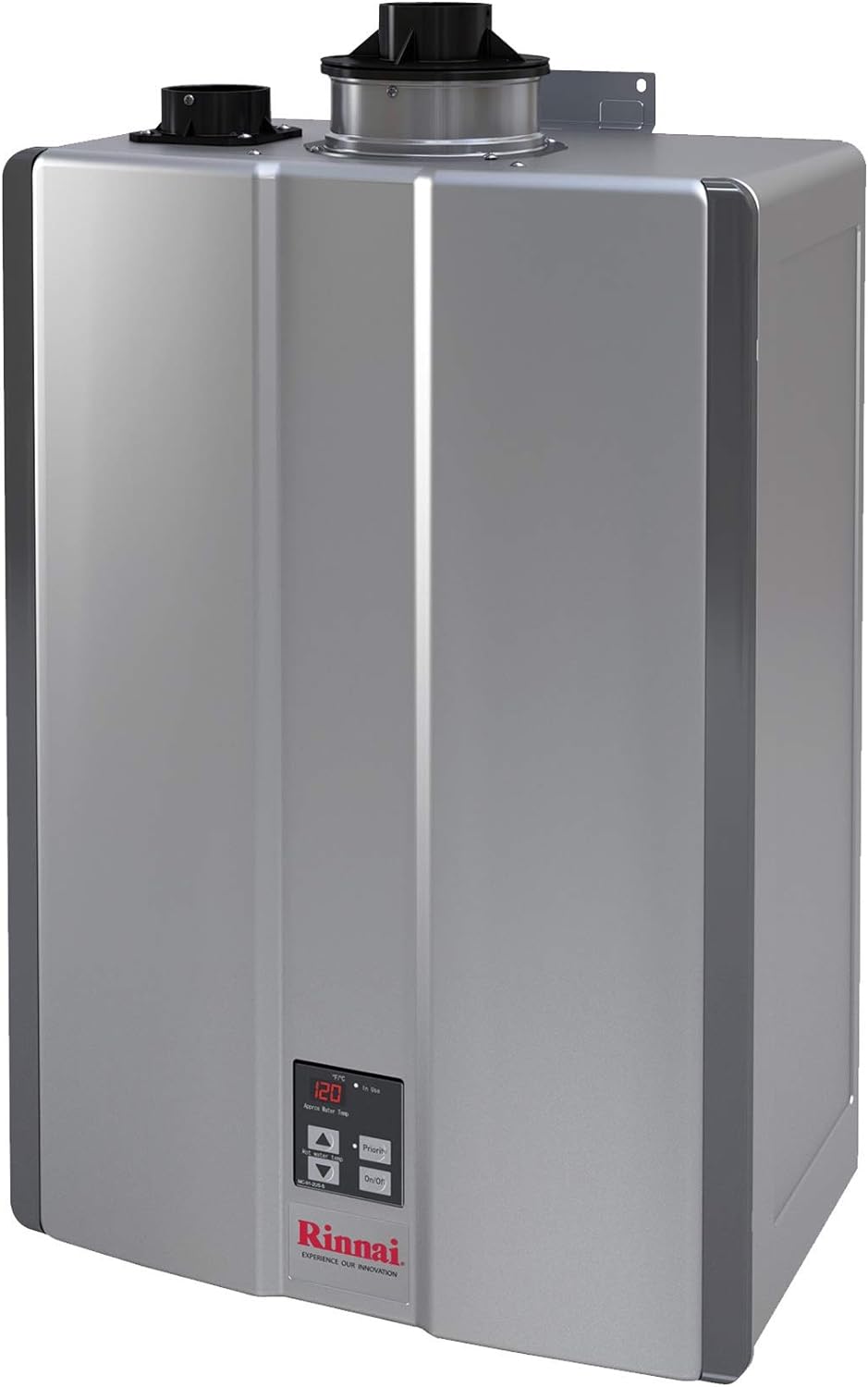
The Rinnai RX199iN and RXP199iN top the efficiency ranking at UEF 0.98, putting them in the maximum rebate tier at SoCalGas and similar programs. The RX199iN runs around $1,538 on Amazon; the RXP199iN adds Smart-Sense auto-modulation and costs approximately $1,833. Both deliver 11.1 GPM max output and are ENERGY STAR Most Efficient certified.
The Rinnai RU199iN at UEF 0.93 is a more affordable condensing option at around $1,879 (pricing reflects a unit that has been on the market longer and sits at a different spec tier). It qualifies for most state programs and mid-tier utility rebates.
Navien's NPE-A2 and NPE-S2 series also rate at UEF 0.96 and qualify for most maximum-tier programs. Navien is not always available through Amazon directly - check authorized HVAC distributors for current availability and pricing.
Gas Tankless vs Heat Pump: The 2026 Financial Comparison
With the federal credit gone, the financial picture for gas tankless buyers has shifted. Heat pump water heaters now carry substantially larger incentives in most markets, and the comparison deserves an honest look.
| Factor | Gas Condensing Tankless | Heat Pump Water Heater |
|---|---|---|
| Federal tax credit (2026 install) | $0 | $0 |
| Utility / state rebates (typical) | $0 - $1,500 | $300 - $2,500+ |
| Unit cost (installed) | $1,500 - $3,500 | $1,000 - $2,500 |
| Annual operating cost (avg. household) | $250 - $400/yr | $100 - $180/yr |
| Hot water capacity | Unlimited (on-demand) | 40 - 80 gallon tank; recovery time applies |
| Space requirement | Small (wall-mount) | Large (floor-standing, 7' ceiling minimum) |
| Climate sensitivity | Works everywhere | Less efficient below 40 degF; needs interior space |
| Payback period vs. tank heater | 6 - 12 years | 3 - 7 years (with rebates) |
When gas tankless still wins: High hot water demand households (more than 80 gallons per day), homes with limited floor space for a 50-gallon tank, climates with very cold winters where heat pump efficiency drops, or buyers replacing a gas system who want to stay on gas.
When heat pump makes more sense: Moderate hot water demand, a garage or basement with adequate height and ambient temperature, access to large utility rebates, and a long-term plan to reduce natural gas dependence. See our full hybrid vs tankless cost breakdown for 10-year math by climate zone.
How to Find and Claim a Rebate for a 2026 Install
The process for claiming a utility rebate is different from a federal tax credit - you are not filing a form with the IRS. Instead:
- Search DSIRE first. Go to dsireusa.org, enter your ZIP code, and filter for water heater incentives. This shows every active federal, state, and utility program in your area. Note which programs are accepting applications now vs. waitlisted.
- Call your gas utility. Confirm the program is active, your chosen model is on the approved product list, and get the rebate application form before purchasing. Some utilities require pre-approval or a pre-installation inspection.
- Buy the qualifying unit. Purchase from an authorized retailer or your installer's supplier. Save all receipts - you will need the invoice showing model number, purchase date, and price.
- Have a licensed contractor install it. Most utility rebate programs require licensed installation. DIY installation typically disqualifies the rebate. Get an itemized installation invoice.
- Submit the rebate application within the deadline. Most programs require submission within 60 days of installation. Delays past the window forfeit the rebate. Applications typically require: proof of purchase, installation invoice, model number, and sometimes a photo of the installed unit.
- Track the rebate check. Utility rebates typically arrive as a check or bill credit within 6 to 12 weeks of a complete application.
The 2026 Buyer's Verdict
The federal 25C credit is gone and is not coming back in any foreseeable legislation. For 2026 buyers, the practical options are:
- If you are in SoCalGas territory: A condensing Rinnai or Navien with UEF 0.95+ can still net $1,300 to $1,500 in utility rebates - meaningfully offsetting the premium for a condensing unit. Check SoCalGas's current approved product list before purchasing.
- If you are in Oregon: The Energy Trust $400 rebate for natural gas tankless is available through NW Natural, Cascade, and Avista customers. Pair it with a Rinnai RU199iN for the best value.
- If you are in most other states: Gas tankless rebates are limited or nonexistent in 2026. Consider whether a heat pump water heater (with larger state/utility rebates and lower operating costs) serves your needs. See the hybrid vs tankless comparison.
- If you need a replacement now and rebates are unavailable: A condensing unit still pays back faster than a non-condensing model through lower fuel bills - UEF 0.98 vs 0.82 translates to roughly 20% lower energy consumption on a per-gallon basis. The rebate is a bonus; the efficiency savings are permanent.
Among condensing units, the Rinnai RX199iN remains the top pick at UEF 0.98. For buyers who want maximum output at a slightly lower price point, the Rinnai RU199iN is the proven budget-condensing option with over a decade of field reliability data. Both qualify for state programs requiring ENERGY STAR Most Efficient certification.
Related Guides
- Claiming the 2025 Tankless Tax Credit: Form 5695 Walkthrough
- Hybrid Heat Pump vs Tankless: 10-Year Cost Comparison
- Best Tankless Water Heaters for Cold Climates
- Condensing vs Non-Condensing: Efficiency & Real Cost Savings
Frequently Asked Questions
Is there a federal tax credit for tankless water heaters in 2026?
No. The federal 25C Energy Efficient Home Improvement Credit for tankless water heaters ended December 31, 2025, under the One Big Beautiful Bill Act signed July 4, 2025. No federal credit is available for any tankless water heater installed on or after January 1, 2026. If you installed a qualifying unit in 2025 and have not yet filed, extension filers have until October 15, 2026 - see our 2025 tax credit guide for the Form 5695 walkthrough.
What rebates are available for tankless water heaters in 2026?
For 2026 installs, savings come from state and utility programs, not federal tax credits. SoCalGas offers $80 to $1,500 depending on UEF rating - top tier Rinnai 0.98 UEF units qualify for $1,300 to $1,500. Oregon's Energy Trust offers $400 for qualifying natural gas tankless units. Most other states have shifted rebate funding toward heat pump water heaters. Search dsireusa.org by ZIP code to find current programs in your area.
What ENERGY STAR rating does a tankless water heater need in 2026?
For most state and utility rebate programs in 2026, a gas tankless water heater needs ENERGY STAR Most Efficient certification, which requires a Uniform Energy Factor (UEF) of 0.95 or higher. Condensing models from Rinnai, Navien, Rheem, and Noritz typically meet this threshold. Some utility programs (like SoCalGas base tier) accept lower UEF ratings starting at 0.82, but the maximum rebates go to units with UEF 0.95 or better.
Should I buy a tankless water heater or heat pump water heater in 2026?
For most homeowners, a heat pump water heater now offers better financial return in 2026. State and utility rebates for heat pump water heaters are substantially larger - often $300 to $2,500 - compared to gas tankless rebates of $80 to $1,500. Heat pump operating costs run 2-3x lower than gas tankless. However, if you have high hot water demand, natural gas access, and need instant whole-home delivery, a condensing gas tankless still makes sense technically and financially.
Can I still claim the 2025 tankless water heater tax credit?
Yes, if your unit was installed on or before December 31, 2025. The credit applies to the tax year the unit was placed in service. Extension filers have until October 15, 2026, to file their 2025 return and claim the $600 credit (30% of unit plus labor cost, capped at $600 for gas tankless). Use IRS Form 5695, Part II. See our dedicated 2025 tax credit guide for the full Form 5695 walkthrough.
Which gas tankless water heater has the highest UEF rating in 2026?
The Rinnai RX199iN and RXP199iN condensing models lead at UEF 0.98 - the highest rating available for residential gas tankless units. Both are ENERGY STAR Most Efficient certified and qualify for maximum utility rebate tiers. The Rinnai RU199iN condensing rates at UEF 0.93 and is a more affordable option that still qualifies for most state programs requiring ENERGY STAR certification.
How do I find utility rebates for a tankless water heater in my area?
Start with dsireusa.org - the DSIRE database lists all active state and utility incentive programs searchable by ZIP code. Also check your gas utility's website directly. Call your local gas utility's efficiency hotline to confirm the program is currently accepting applications and that your chosen model is on the approved product list before purchasing.
Affiliate Disclosure: TanklessGeek participates in the Amazon Services LLC Associates Program, an affiliate advertising program designed to provide a means for sites to earn commissions by linking to Amazon.com. We earn commissions from qualifying purchases made through our Amazon links at no additional cost to you. These commissions support our research, testing, and content creation. We recommend products based on specifications, performance, and value, not commission rates.
Photos provided by Pexels.