Best Tankless Water Heater for 2 Bathrooms: Exact Size and Models 2026
Updated: September 2026 | By TanklessGeek Editorial
A 2-bathroom home has a specific hot water demand profile: two showers potentially running at the same time, a kitchen sink, and a dishwasher - all competing for a single tankless unit's output. Get the sizing right and you never notice the unit is there. Get it wrong and you get lukewarm showers the moment someone else turns on a tap.
The target for a 2-bathroom home is 6-8 GPM. That covers two standard showers (1.5-2.5 GPM each) plus kitchen or laundry simultaneously. In cold climates, where winter groundwater below 50 degrees F cuts rated flow by 30-40%, size to the high end of that range. This guide covers the exact sizing math, four verified models across gas and electric, and which climate scenarios push you toward each.
Affiliate Disclosure: TanklessGeek participates in the Amazon Services LLC Associates Program. We earn commissions from qualifying purchases through our Amazon links at no extra cost to you. We recommend products based on specifications, performance, and value, not commission rates.
Quick Picks: Best Tankless for 2 Bathrooms
Verified prices and availability as of September 2026. All ASINs confirmed live on Amazon.
| Model | Fuel | GPM | BTU / kW | UEF | Price | Best For | Buy |
|---|---|---|---|---|---|---|---|
| Rinnai RU199iN | Gas | 11 GPM | 199,000 BTU | 0.96 | ~$1,384 | Cold climate, whole-home | Check Price on Amazon |
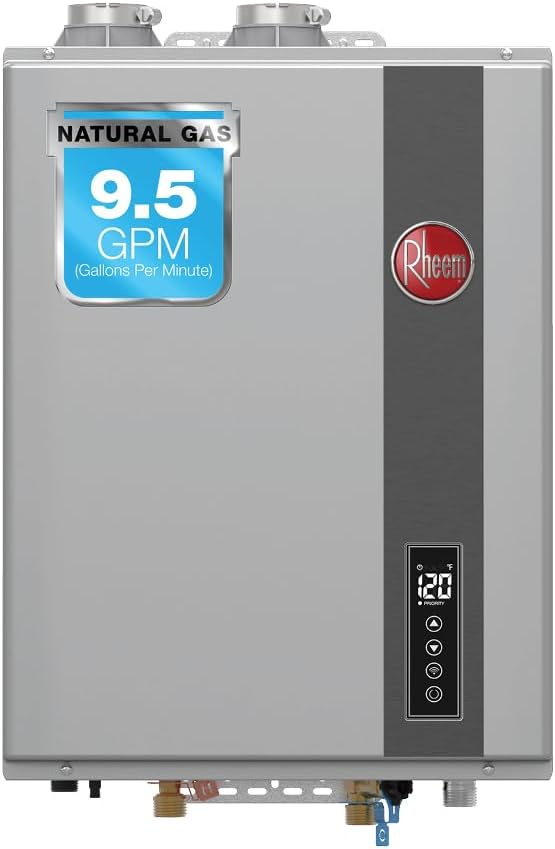
| Rheem RTGH-95DVLN-2 | Gas | 9.5 GPM | 199,900 BTU | 0.93 | ~$1,499 | 2-bath, 15-yr warranty | Check Price on Amazon |
| Rheem RTG-95DVLN-3 | Gas | 9.5 GPM | 199,900 BTU | 0.82 | ~$949 | Budget gas, 2-4 bath | Check Price on Amazon |
| EcoSmart ECO 36 | Electric | 6-8.7 GPM | 36 kW | 0.99 | ~$451 | Electric, warm climate only | Check Price on Amazon |
GPM Sizing for a 2-Bathroom Home: The Math
The 6-8 GPM target comes from adding up simultaneous fixture demand:
| Fixture | Flow Rate | Simultaneous Use? |
|---|---|---|
| Shower (standard 1.5 GPM head) | 1.5-2.0 GPM | Yes, peak morning |
| Second shower | 1.5-2.0 GPM | Yes, peak morning |
| Kitchen sink | 1.0-1.5 GPM | Yes |
| Dishwasher | 1.0-1.5 GPM | Sometimes |
| Bathroom sink (washing hands) | 0.5-1.0 GPM | Sometimes |
| Peak simultaneous total | 5.5-8.0 GPM |
The math says 6-8 GPM handles genuine peak demand. The climate adjustment is where most buyers go wrong: if your winter groundwater comes in at 45 degrees F (common in Michigan, Minnesota, and New England), a gas unit rated at 9.5 GPM at 77 degree inlet still delivers its full rated output - gas BTU output does not depend on inlet water temperature. An electric unit rated at 8.7 GPM at 80 degree inlet may only deliver 3.5 GPM at 45 degree inlet. The physics does not change because the marketing says "whole home."
Rule of thumb: In any state north of the Mason-Dixon line or at elevation above 3,000 feet, choose gas or size the electric unit assuming 50% output reduction in winter.
Gas vs Electric for 2 Bathrooms: The Real Trade
The choice between gas and electric for a 2-bathroom home is almost always settled by two factors: what fuel you already have and what your winter groundwater temperature is.
| Factor | Gas Tankless | Electric Tankless |
|---|---|---|
| Cold climate performance | Full rated GPM regardless of inlet temp | Loses 30-50% output below 50 deg F inlet |
| Peak GPM at 199K BTU / 36kW | 9-11 GPM | 3.6-8.7 GPM (climate-dependent) |
| Electrical requirement | 120V outlet only | 150A dedicated (4x 40A breakers) |
| Venting | Requires direct vent flue | None required |
| Unit cost | $800-$1,500 | $400-$850 |
| Typical installed cost | $1,500-$3,500 | $1,500-$4,500 (panel upgrade often needed) |
| Energy efficiency | 0.82-0.98 UEF | 0.99 UEF |
| Annual operating cost (US avg) | Lower (gas costs less per BTU in most regions) | Higher unless rates are low or solar offsets |
Gas wins on reliability across all climates and on total installed cost when a 150-amp electrical upgrade is factored in. Electric wins on unit price, zero-venting simplicity, and near-perfect efficiency - but only delivers on those advantages in warm climates with adequate panel capacity already in place.
Best Overall: Rinnai RU199iN (Gas, 11 GPM)
The Rinnai RU199iN is the standard against which other residential gas tankless units are measured. At 11 GPM rated output (199,000 BTU condensing), it covers a 2-bathroom home with headroom to spare - running two showers, a dishwasher, and a kitchen sink simultaneously without any drop in temperature at any fixture.
Key specs:
- 199,000 BTU condensing, 0.96 UEF
- 11 GPM maximum flow rate
- Indoor installation with direct-vent or power-vent flue
- Wi-Fi capable via Rinnai's Control-R module (sold separately)
- 120V, 5A electrical connection only
- 12-year heat exchanger, 5-year parts, 1-year labor warranty
- Dimensions: 18.5"W x 30"H x 11"D, 55 lbs
Why it tops the list for 2-bathroom homes: condensing design means 0.96 UEF efficiency (recapturing heat from flue gases), the 11 GPM rating provides genuine cold-climate headroom, and Rinnai's service network is the most widely distributed in North America. If a tech is needed, one is typically available within a few days rather than weeks.
The RU199iN requires a 3/4" gas line and a condensate drain for the secondary heat exchanger - plan for both in the installation quote. If your current gas line is 1/2" and runs more than 20 feet from the meter, upsizing the line to 3/4" is standard practice for a unit this size.
Best Condensing with Longest Warranty: Rheem RTGH-95DVLN-2 (Gas, 9.5 GPM)
The Rheem RTGH-95DVLN-2 is Rheem's Prestige condensing indoor gas tankless - 9.5 GPM at 199,900 BTU with a 0.93 UEF and the longest heat exchanger warranty in its class: 15 years. For a 2-bathroom home it covers peak demand comfortably, and the 15-year coverage means the core component that fails first on any tankless is protected for the better part of the unit's usable life.
Key specs:
- 199,900 BTU condensing, 0.93 UEF
- 9.5 GPM maximum flow rate
- Supports up to 4 bathrooms per Rheem specs
- Rheem's exclusive Hot Start Programming (reduces cold-water burst between back-to-back uses)
- Leak detection included
- 15-year heat exchanger, 5-year parts, 1-year labor warranty
- Dimensions: 18.5"W x 27.5"H x 9.75"D, 77 lbs
Hot Start Programming is the differentiator here for 2-bathroom households: it keeps the unit in a ready state between back-to-back uses, reducing the cold-water slug that hits the first few seconds of a new draw. In a 2-bath home where showers are staggered rather than simultaneous, this is a noticeable quality-of-life improvement.
The RTGH-95DVLN-2 is heavier and slightly larger than the Rinnai RU199iN - plan for adequate wall support during installation. The condensate drain requirement is the same as the Rinnai.
Best Budget Gas: Rheem RTG-95DVLN-3 (Gas, 9.5 GPM)
At $949, the Rheem RTG-95DVLN-3 is the most accessible path to reliable 2-bathroom whole-home hot water. It is non-condensing (0.82 UEF vs 0.93 for the condensing RTGH version) but delivers the same 9.5 GPM maximum flow from 199,900 BTU. For a 2-bath home, that output is more than enough.
Key specs:
- 199,900 BTU non-condensing, 0.82 UEF
- 9.5 GPM maximum flow rate
- Supports up to 3.5 bathrooms per Rheem specs
- Hot-start programming
- No condensate drain required (advantage over condensing units in retrofit)
- Compact: 13.5"W x 24.2"H x 10.27"D, 46.5 lbs
The non-condensing design has one meaningful installation advantage in retrofits: no condensate drain. Condensing units produce acidic condensate that requires a neutralizer and a drain line routed to a floor drain or utility sink. In some installations - basement mechanical rooms without floor drains, for example - adding that drain is a significant labor item. The RTG-95DVLN-3 skips that entirely, simplifying the install and reducing labor cost.
The efficiency trade is real: non-condensing at 0.82 UEF versus condensing at 0.93-0.96 UEF means higher annual gas bills. Run the math for your local gas rate - in most markets, the $400-$550 unit-cost savings takes 4-8 years to break even against the efficiency difference. If you plan to stay in the home long-term, condensing pays. For shorter time horizons or tight installation budgets, the RTG-95DVLN-3 delivers the same hot water performance at a meaningfully lower entry cost.
Best Electric (Warm Climates Only): EcoSmart ECO 36 (36kW, 6-8.7 GPM)
The EcoSmart ECO 36 is the best electric tankless for a 2-bathroom home - but only if you are in a warm climate. At $451 with a lifetime warranty, it costs a fraction of comparable gas units. The catch is the 150-amp dedicated electrical requirement and the physics of electric heating in cold groundwater.
Key specs:
- 36kW at 240V, 0.99 efficiency
- 3.6-8.7 GPM depending on inlet water temperature
- Requires 4 x 40A double-pole breakers, four runs of 8-gauge copper
- Patented self-modulating technology
- Digital temperature control in 1-degree increments
- Lifetime warranty on unit and copper heat exchanger
- Compact: 21"W x 17"H x 3.6"D, 18.35 lbs
Flow rate by climate:
| Inlet Water Temp (Winter) | ECO 36 Output | Covers 2-Bath Peak? |
|---|---|---|
| 80 deg F (Florida, Gulf Coast) | 8.7 GPM | Yes, comfortably |
| 70 deg F (Southern CA, TX) | 6.0 GPM | Yes, 2 showers + sink |
| 60 deg F (Mid-Atlantic, Pacific NW) | 4.8 GPM | Marginal - 2 showers only |
| 50 deg F (Great Lakes, New England) | 3.8 GPM | No - 1 shower at a time |
| 40 deg F (Northern states, mountains) | 3.0 GPM | No - use gas instead |
If your state is north of Virginia and you use electric heat, budget for a panel upgrade: the ECO 36 needs 150 amps of dedicated capacity, and most 200-amp all-electric panels are already loaded with HVAC, dryer, and range circuits. Panel upgrades to 400-amp service run $1,500-$3,000 installed, eliminating the unit-cost advantage over gas. In warm climates with gas appliances (partial electrical panel capacity available), the ECO 36 is a strong value choice.
How to Choose: A 2-Bath Decision Framework
Use this decision path before you buy:
- What is your winter groundwater temperature? Check USGS data or search "[your state] average groundwater temperature." Below 55 degrees F means electric tankless will not cover 2-bath simultaneous demand.
- Do you have natural gas or propane? If yes, go gas. The performance advantage over electric in any climate below 65 degrees F inlet is decisive.
- What is your electrical panel situation? If you have gas and are choosing electric tankless anyway (solar offsets, gas is unavailable), get a licensed electrician to assess available breaker capacity before purchasing the ECO 36 or any 36kW unit.
- How long do you plan to stay in the home? More than 10 years: condensing gas (Rinnai RU199iN or Rheem RTGH) pays back through efficiency. Under 5 years: non-condensing gas (Rheem RTG-95DVLN-3) gives the same performance at lower entry cost.
- Is the retrofit simple or complex? Existing gas line near the install location, existing venting path, floor drain for condensate: go condensing. Retrofit without existing infrastructure: non-condensing gas reduces the installation complexity and cost.
Installation Checklist for 2-Bathroom Tankless
Before your installer arrives, confirm these items are in scope:
- Gas line sizing: 3/4" minimum for any unit above 150,000 BTU. If existing supply line is 1/2", factor in line upgrade cost.
- Venting: Direct-vent (two-pipe) or power-vent (one pipe). Condensing units require PVC schedule 40 flue pipe. Non-condensing requires stainless or Category III liner. Confirm with your installer which applies.
- Condensate drain: Condensing units only. Needs neutralizer cartridge and drain to floor drain or utility sink. Add to scope if not present.
- 120V outlet: All gas tankless units require a standard 120V outlet within 6 feet. Confirm one exists at the install location.
- Cold water isolation valve: Required for maintenance flushing (descaling). Install one if not already present on the cold supply line.
- Pressure relief valve: Required by code on all water heater installations. Confirm included in scope.
- Permit: Required in most jurisdictions for water heater replacement. Confirm your installer pulls the permit - permits protect you on resale.
Frequently Asked Questions
How many GPM do I need for a 2-bathroom house?
A 2-bathroom home typically needs 6-8 GPM from a whole-house tankless water heater. Two showers running simultaneously at 1.5-2.5 GPM each plus a kitchen sink at 1.5 GPM adds up to 4.5-6.5 GPM peak demand. Size up to 7-8 GPM in cold climates where groundwater below 50 degrees F reduces the unit's rated output by 20-40%. Gas tankless units in the 160,000-199,000 BTU range (7-11 GPM rated) comfortably cover 2-bath demand. Electric units require 36kW or more, and even then fall short in cold climates.
Is gas or electric tankless better for a 2-bathroom home?
Gas is better for most 2-bathroom homes. A 199,000 BTU gas tankless delivers 9-11 GPM regardless of climate, handles simultaneous fixtures without compromise, and requires only a standard 120V outlet - no panel upgrades. Electric tankless at 36kW delivers 6-8 GPM in warm climates but drops to 3-4 GPM in cold climates, and requires 150 amps of dedicated electrical capacity that most homes do not have. Gas wins on performance and total installed cost in most scenarios.
What size tankless water heater do I need for a 3-bedroom 2-bathroom house?
A 3-bedroom 2-bathroom house needs a 7-9 GPM tankless water heater in most climates. For gas, any condensing unit in the 160,000-199,000 BTU range handles this comfortably. For electric, 36kW covers the demand in warm climates (groundwater above 60 degrees F) but falls short in cold climates where you need gas instead. If you are in a northern state with winter groundwater below 50 degrees F, a 199,000 BTU gas condensing unit is the reliable choice.
Can a tankless water heater run two showers at once?
Yes, if sized correctly. Two showers at 1.5-2.5 GPM each require 3-5 GPM from the heater. Any gas condensing tankless at 140,000 BTU or above covers this easily. Electric units at 36kW cover it in warm climates. The issue is simultaneous demand across the whole house - two showers plus a dishwasher and kitchen sink running at the same time. Gas condensing units at 199,000 BTU (9-11 GPM) handle that full simultaneous load without compromise.
How much does it cost to install a tankless water heater in a 2-bathroom home?
Total installed cost for a gas tankless in a 2-bathroom home runs $1,500-$3,500 depending on complexity. The unit itself costs $800-$1,500. Labor for a straightforward swap runs $500-$1,000. Complications that add cost: new gas line sizing ($300-$800), direct-vent flue installation in a retrofit ($400-$1,200), and permit fees ($50-$300). Electric tankless installation adds panel costs - if a panel upgrade to 400-amp service is needed, add $1,500-$3,000.
Does climate affect which tankless water heater I should buy for 2 bathrooms?
Yes, significantly. In cold climates (groundwater below 55 degrees F in winter - most states north of the Mason-Dixon line), electric tankless units lose 30-50% of their rated flow rate and often cannot support two fixtures simultaneously. Gas tankless units maintain their rated output regardless of groundwater temperature. If you are in Michigan, Minnesota, New England, or any mountain state, choose gas condensing. If you are in Florida, Texas, or Southern California, electric tankless at 36kW can work for 2-bath coverage.
What is the best budget tankless water heater for 2 bathrooms?
The Rheem RTG-95DVLN-3 at around $949 is the best budget gas option for a 2-bathroom home. It delivers 9.5 GPM, covers 3-4 bathrooms per Rheem's own specs, and non-condensing design keeps the unit cost down while still handling whole-home demand. The EcoSmart ECO 36 at $451 is the budget electric option, but requires 150 amps of dedicated electrical capacity - the electrical upgrade cost often negates the unit savings. For cold climates, budget gas beats budget electric at every price point.
The 2026 Verdict
For the vast majority of 2-bathroom homes, a gas condensing tankless at 199,000 BTU is the right answer. The Rinnai RU199iN is the performance leader at $1,384 with 11 GPM and 0.96 UEF - headroom for the coldest climates and the most demanding morning routines. The Rheem RTGH-95DVLN-2 at $1,499 earns its price with a 15-year heat exchanger warranty that protects the single most expensive component on any tankless unit. The Rheem RTG-95DVLN-3 at $949 delivers the same 9.5 GPM output in a simpler, lighter non-condensing package that costs less to install in retrofits without floor drains.
If you have a warm climate and existing electrical panel capacity, the EcoSmart ECO 36 at $451 delivers whole-home electric coverage with a lifetime warranty that no gas competitor matches. Do the panel assessment first.
The 2-bathroom sizing sweet spot - 6-8 GPM from any of these four verified units - means your showers stay hot no matter who else in the house turns on a tap. That is the standard every replacement water heater should meet.
Related Articles
- Tankless Water Heater No Hot Water or Delay: Causes and Fixes
- Best Tankless Water Heaters for Cold Climates and High Altitude
- Tankless Water Heater Rebates 2026: What Replaced the Tax Credit
- Condensing vs Non-Condensing Tankless: Efficiency and Real Cost Savings
Affiliate Disclosure: TanklessGeek participates in the Amazon Services LLC Associates Program, an affiliate advertising program designed to provide a means for sites to earn commissions by linking to Amazon.com. We earn commissions from qualifying purchases made through our Amazon links at no additional cost to you. These commissions support our research, testing, and content creation. We recommend products based on specifications, performance, and value, not commission rates. As an Amazon Associate I earn from qualifying purchases.
Photos provided by Pexels.