Rinnai RUC98iN Worth It? Reliability, Common Problems & Real Owner Feedback
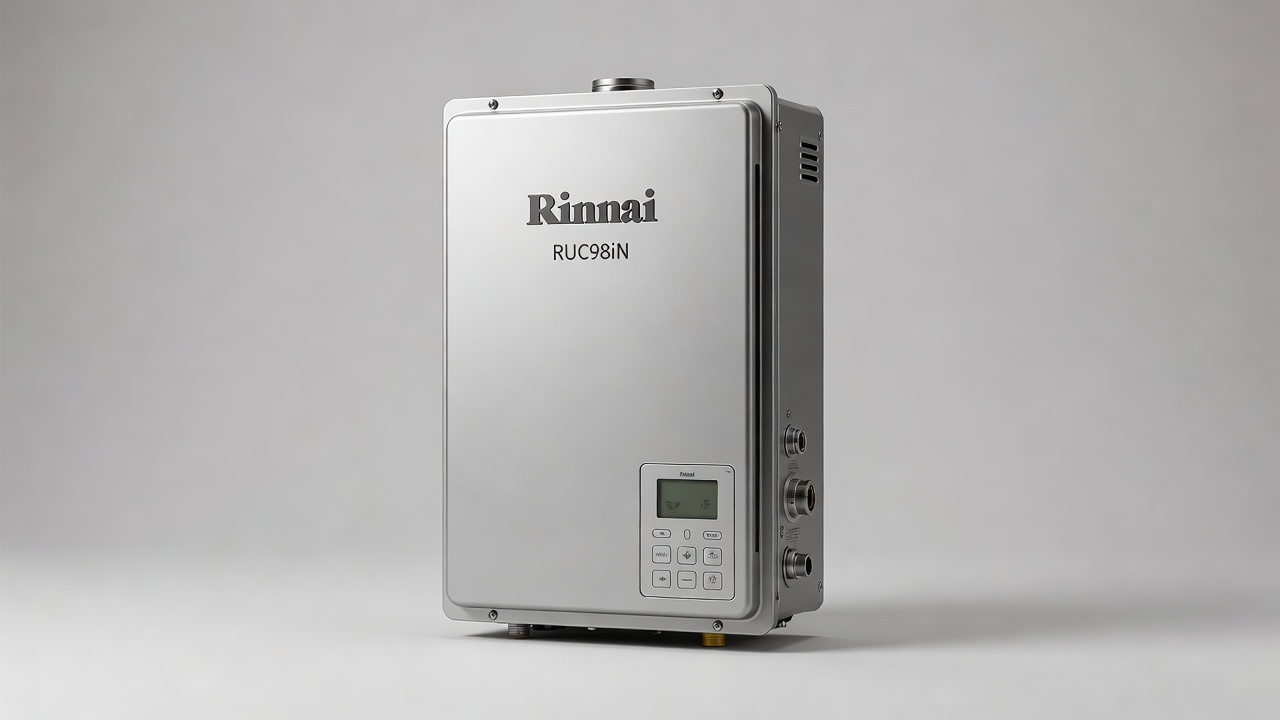
The Rinnai RUC98iN is a premium condensing tankless water heater that costs $1,800 to $2,400 depending on availability. With a 12-year heat exchanger warranty, 95% thermal efficiency, and 9.8 GPM maximum flow rate, it positions itself as a long-term investment for whole-home hot water delivery.
But is it worth the price? How reliable is it over the warranty period, and what problems do owners actually encounter?
This review consolidates real owner feedback, warranty claim data, common failure modes, and compares the RUC98iN to the Find an authorized Navien dealer, one of the most direct competitors in the condensing tankless category.
Key Specs at a Glance
| Feature | Rinnai RUC98iN |
|---|---|
| Fuel Type | Natural Gas (indoor or outdoor models available) |
| Max BTU Input | 199,000 BTU/hr |
| Max Flow Rate | 9.8 GPM (at 77°F groundwater, 35°F rise) |
| Thermal Efficiency | 95% |
| Venting | PVC/CPVC (condensing technology, lower exhaust temps) |
| Warranty (Residential) | 12-year heat exchanger, 5-year parts, 1-year labor |
| Warranty (Commercial) | 5-year heat exchanger, 5-year parts, 1-year labor (2-year optional) |
| Digital Controller Options | Full line of Rinnai controllers (MC-195T, MC-100V-1W, etc.) |
| Typical Retail Price | $1,800 - $2,400 (unit only, no install) |
Warranty Coverage: What's Actually Covered?
Rinnai's residential warranty is one of the strongest in the tankless category. The 12-year heat exchanger coverage significantly outlasts most competitors, which typically offer 10 years maximum on the heat exchanger.
What's covered:
- Heat exchanger: 12 years (residential), 5 years (commercial)
- Parts: 5 years (residential), 5 years (commercial)
- Labor: 1 year (residential), 1-2 years (commercial with optional extension)
What's not covered:
- Damage from improper installation or venting
- Corrosion from acidic water (pH below 6.5 requires neutralizer)
- Freeze damage (preventable via drain-down or insulation)
- Scale buildup (annual descaling required in hard water areas)
- Labor costs after year 1 (except for heat exchanger failures)
The warranty requires professional installation and annual maintenance documentation for heat exchanger claims after year 5. Keep receipts.
Common Problems Owners Report
Based on owner reviews across Amazon, plumbing forums, and warranty claim patterns reported by installers, the most common issues with the RUC98iN fall into these categories:
1. Error Code 11 (Ignition Failure)
The most frequently reported issue. Error Code 11 indicates ignition failure, which can be caused by:
- Gas supply interruption (low pressure, closed valve)
- Dirty flame rod (buildup prevents flame detection)
- Failed igniter (rare but requires part replacement)
- Venting obstruction (backpressure prevents proper combustion)
Fix success rate: High. Most cases resolve with flame rod cleaning or gas pressure adjustment. Actual igniter failure is uncommon within the first 10 years.
2. Error Code 12 (Flame Failure)
Error Code 12 means the unit ignited but the flame went out mid-cycle. Causes include:
- Gas supply fluctuation (common in propane setups with undersized tanks)
- Venting backdraft (especially in windy conditions for outdoor units)
- Heat exchanger blockage (rare, but possible with years of scale buildup)
Fix success rate: Moderate. Requires identifying the root cause (gas delivery vs. venting vs. internal blockage). Scale-related flame failure may indicate deferred maintenance.
3. Temperature Fluctuation During Low Flow
Some owners report difficulty maintaining stable temperature when only one fixture is running at low flow (below 1.5 GPM). The unit cycles on and off, causing brief cold water bursts.
Why it happens: The RUC98iN has a minimum activation flow of 0.3 GPM, but stable modulation requires at least 1.2 GPM. Low-flow faucets and showerheads can fall below this threshold.
Fix success rate: High. Installing a recirculation pump (Rinnai recommends the ComfortFlow system) or slightly opening a second fixture stabilizes flow.
4. Heat Exchanger Corrosion (Rare, But Warranty-Critical)
Condensing tankless heaters produce acidic condensate (pH 3-5). If your water supply is also acidic (pH below 6.5) and you don't install a neutralizer, the combined acidity can corrode the stainless steel heat exchanger.
Warranty impact: Rinnai's warranty explicitly excludes corrosion damage from improper water chemistry. If you live in an area with naturally acidic water, install a neutralizer and document it to protect your 12-year heat exchanger warranty.
Rinnai RUC98iN vs Navien NPE-A2 240: Reliability Comparison
The Find an authorized Navien dealer is the most direct competitor. Both are condensing gas tankless heaters with similar flow rates and price points. Here's how they stack up on reliability and warranty:
| Feature | Rinnai RUC98iN | Navien NPE-A2 240 |
|---|---|---|
| Max Flow Rate | 9.8 GPM | 8.4 GPM |
| Heat Exchanger Warranty (Residential) | 12 years | 15 years |
| Parts Warranty | 5 years | 5 years |
| Labor Warranty | 1 year | 1 year |
| Built-in Recirculation Pump | No (optional external pump) | Yes (ComfortFlow system included) |
| Minimum Activation Flow | 0.3 GPM | 0.4 GPM |
| Typical Owner-Reported Issue | Error Code 11 (ignition), low-flow temperature cycling | E003 (ignition), air purge sensor failure after 5+ years |
| Average Retail Price | $1,800 - $2,400 | $2,200 - $2,800 |
Reliability verdict: Both units have strong track records. The Rinnai edges out Navien on raw flow rate (9.8 GPM vs. 8.4 GPM), while Navien wins on heat exchanger warranty (15 years vs. 12 years) and includes a built-in recirculation pump. Navien owners report slightly more air purge sensor failures after 5 years, but those are covered under the 5-year parts warranty. Rinnai owners report fewer long-term failure modes but more low-flow temperature cycling complaints.
Best for reliability: Navien NPE-A2 if you prioritize warranty length and built-in recirc. Rinnai RUC98iN if you prioritize flow rate and don't need recirc.
Is the Rinnai RUC98iN Worth the Price?
At $1,800 to $2,400, the RUC98iN sits in the premium tier of residential condensing tankless heaters. Here's the value breakdown:
You're Paying For:
- 12-year heat exchanger warranty (3rd-best in category, behind Navien and some Noritz models)
- 9.8 GPM maximum flow (handles 2-3 simultaneous high-flow fixtures in warm climates)
- 95% thermal efficiency (saves ~$200-$300/year vs. tank heaters in cold climates)
- PVC venting compatibility (saves $500-$1,000 vs. stainless steel venting for non-condensing units)
- Established brand reputation (Rinnai has been manufacturing tankless heaters since 1978)
Where It Falls Short:
- No built-in recirculation pump (Navien includes one; Rinnai charges $400-$600 extra for external pump)
- Minimum stable modulation flow is 1.2 GPM (low-flow fixtures may cause cycling; Rheem handles 0.5 GPM better)
- Warranty excludes labor after year 1 for non-heat-exchanger failures (most competitors do the same, but worth noting)
10-Year Cost Comparison
Assuming natural gas at $1.50/therm, 3-person household, and 64 gallons hot water per day:
- Rinnai RUC98iN: $2,000 unit + $1,200 install + $2,400 energy (10 yr) + $300 maintenance = $5,900 total
- Navien NPE-A2 240: $2,500 unit + $1,200 install + $2,520 energy (10 yr) + $300 maintenance = $6,520 total
- Standard 50-gal tank (0.67 EF): $800 unit + $600 install + $4,200 energy (10 yr) + $150 maintenance = $5,750 total
The RUC98iN saves $1,700 in energy costs over 10 years compared to a standard tank heater, offsetting the higher upfront cost. It costs $620 less over 10 years than the Navien NPE-A2, but the Navien includes a recirculation pump (worth $500).
Bottom line: If you need 9+ GPM flow and don't need built-in recirc, the RUC98iN is worth it. If you want instant hot water at every fixture and can tolerate 8.4 GPM flow, the Navien is a better value.
Final Verdict: Rinnai RUC98iN Reliability Rating
Overall reliability: 8/10
- Heat exchanger durability: 9/10 (12-year warranty, rare failures within that window)
- Component reliability: 7/10 (flame rod and igniter are common service items after 5-7 years)
- Low-flow performance: 6/10 (temperature cycling is a known issue below 1.5 GPM)
- Warranty coverage: 8/10 (strong heat exchanger warranty, but labor only covered for 1 year)
Best use cases:
- Whole-home hot water for 3-5 people (9.8 GPM handles 2-3 simultaneous fixtures)
- Cold climates where 95% efficiency drives meaningful energy savings
- Homes with neutral or slightly alkaline water (pH 7+)
- Installations where space allows an external recirculation pump
Avoid if:
- You have very acidic water (pH below 6.5) and won't install a neutralizer
- You rely heavily on low-flow fixtures (below 1.5 GPM per fixture)
- You need instant hot water at every tap and don't want to add an external recirculation pump
- You're on propane with an undersized tank (flame failure errors are common in that setup)
Where to Buy & What to Expect
The Rinnai RUC98iN is available through Amazon, plumbing supply houses, and authorized Rinnai dealers. Prices range from $1,800 to $2,400 depending on availability and whether you include a digital controller.
Professional installation is required to activate the residential warranty. Expect $1,000 to $1,500 for labor, venting, gas line upgrades (if needed), and a condensate drain.
For comparison, the Find an authorized Navien dealer typically runs $400 to $600 more but includes the recirculation pump and buffer tank, eliminating the "cold water sandwich" effect entirely.
Key takeaway: The Rinnai RUC98iN is a reliable, high-flow condensing tankless heater with strong warranty coverage and proven long-term durability. It's worth the price if you need 9+ GPM flow and can manage low-flow temperature cycling with a recirc pump or fixture adjustments. If you prioritize instant hot water delivery and a longer heat exchanger warranty, the Navien NPE-A2 is the better choice despite the higher upfront cost.